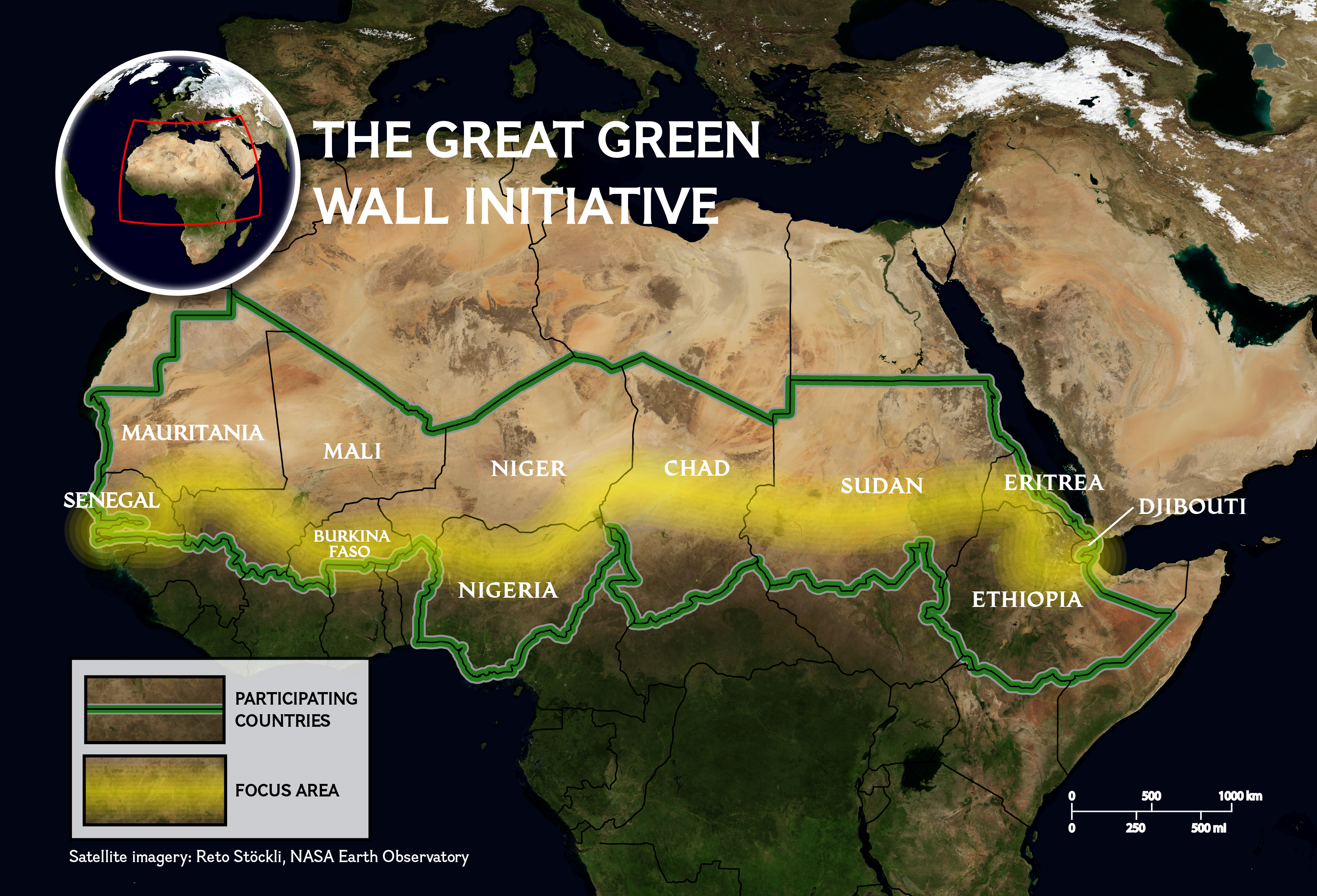
The indiscriminate logging of forests and jungles worldwide is causing a cycle of rising temperatures and soil degradation, which allows deserts and arid zones to expand beyond their natural boundaries. To prevent this from happening in Africa's Green Belt , 11 countries have joined forces to build a natural barrier of trees stretching from east to west, preventing the Sahara from encroaching southward across the continent.
This initiative, known as the Great Green Wall , stretches 8,000 kilometers from Djibouti to Senegal . The project began in 2007. In 2021, during the Paris summit, the European Union, the World Bank, and the African Union pledged $14 million to accelerate the planting efforts.
The goal is to restore 100 million hectares of currently degraded land, capture 250 million tons of carbon , and create 10 million green jobs by 2030. Saving these territories from desertification allows farming communities to continue producing food on nutrient-rich land.
If the goal is met within four years, this will allow:
Recover the fertile land.
To provide economic opportunities for the world's youngest population.
To provide food security for the millions of people who go hungry every day.
Climate resilience in a region where temperatures are rising faster than anywhere else on Earth.
Senegal has planted 12 million trees and Nigeria has reclaimed five million hectares along its northern border. This has allowed farmers to secure productive land for several more years.
According to United Nations (UN) data, the area separating the Sahara Desert from the African savanna is drying up at an accelerated rate, which has also led to a temperature increase of 1.5°C , more than the global average for a century. This has caused desertification to advance between 45 and 60 centimeters per year.
The risk of losing green spaces represents a change in the habitability of the central region of the continent . If this is not reversed, by 2050 nearly 250 million people would have to leave their homes and move to other cities or countries. A single hectare of green space can sequester up to 500 tons of CO2 and feed between three and five local families.
The reality of the Great Green Wall
According to NPR , 18 years after the plan to save the arid Sahel region with this green wall was implemented, only a handful of hectares were actually planted, while the rest fell victim to mismanagement of funds allocated by various international organizations. Billions of dollars were squandered and lost to corruption and successive coups .
According to UN records, more than 135 million people in the region currently depend on degraded lands for survival . Food insecurity, migration, terrorism, and conflicts over resources are on the rise.

No comments:
Post a Comment